
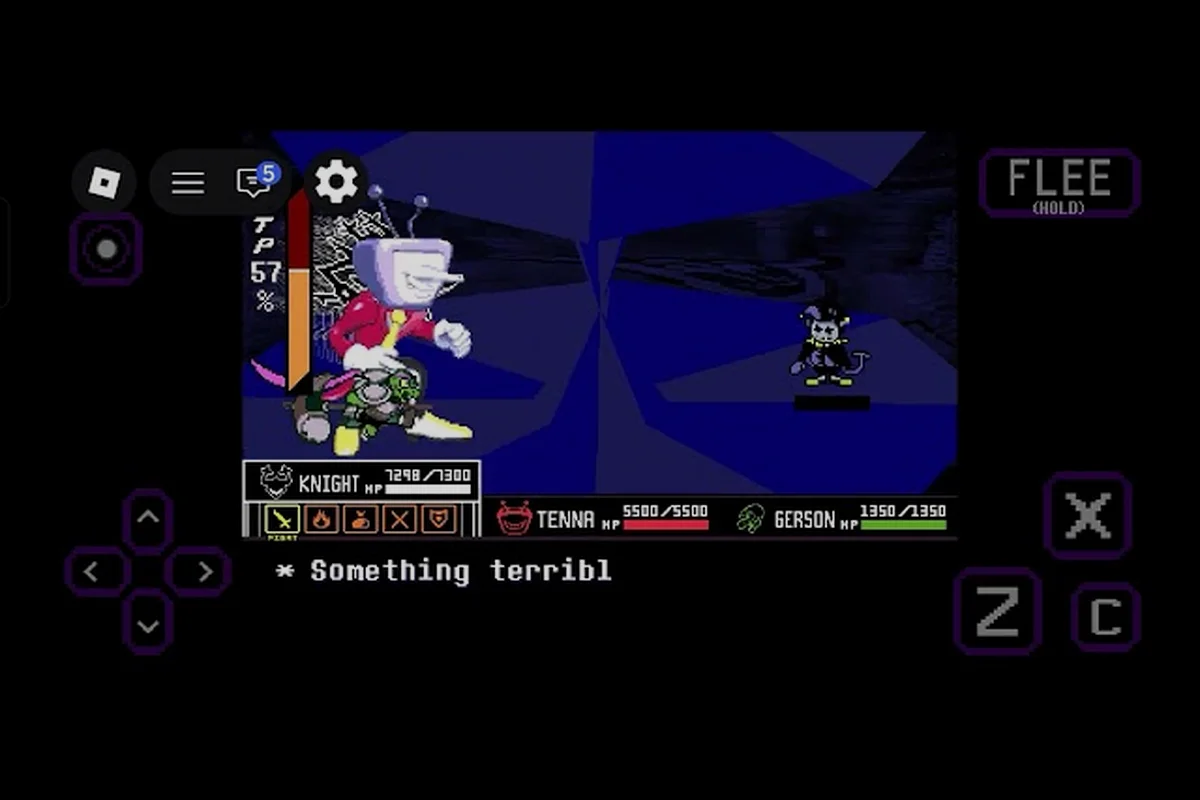
DELTARUNE Fight on Roblox has quietly built a reputation for brutal, pattern-heavy boss encounters that reward patience and punish greed. The confirmed line-up so far — Tenna, King, Pink, and Kaizo Knight — offers enough mechanical variety that the default Standard tier eventually stops feeling dangerous. That is exactly when self-imposed rules become the real game, because they force you to re-learn fights you have already memorized. A dodge-only restriction or a no-damage attempt transforms a comfortable clear into a tense, frame-by-frame puzzle. Community videos show players pushing these ideas further every week, and the result is a surprisingly deep challenge scene for a single-developer Roblox project.
Why Self-Imposed Rules Keep DELTARUNE Fight Fresh
The core loop of DELTARUNE Fight is simple: steer your Soul through bullet patterns, spend TP on attacks when windows open, and survive long enough to deplete a boss health pool. Once you know where every projectile spawns, the default difficulty tiers stop testing your reaction speed and start testing your patience. Self-imposed rules reverse that decay by removing the safety nets you normally rely on. According to community videos, players who commit to a no-damage run often spend more time studying a single phase than they spent clearing the entire game on Standard.
The appeal is not just difficulty for its own sake. A good challenge rule changes what information matters. When you cannot take a single hit, the telegraphed wind-up before a screen-wide sweep becomes more important than the sweep itself. When you cannot attack, positioning stops being a means to an end and becomes the entire fight. This is why the best DELTARUNE Fight challenge ideas are not arbitrary restrictions — they are filters that isolate one specific skill and force you to master it in isolation.
| Challenge Type | Core Skill Tested | Best Starting Boss |
|---|---|---|
| Dodge-only | Movement and spacing | King |
| No-damage | Pattern memorization | Tenna |
| TP-free | Patience and survival | Pink |
| Speedrun | Route optimization | Kaizo Knight |
| One-attempt | Consistency under pressure | Tenna |
The table above is a starting point, not a rigid curriculum. As of the September 2026 build, the confirmed boss order and unlock conditions remain loosely documented, so players often adapt these rules to whichever encounter they can access. The key is to pick a rule that frustrates you in a productive way — one that exposes a weakness you have been ignoring rather than one that simply makes the game longer.
Dodge-Only Runs: The Purest Movement Test
A dodge-only run is the most intuitive DELTARUNE Fight self-imposed rule because it strips away the offensive half of the game entirely. You never spend TP, you never trigger an attack, and you survive purely on movement. This sounds simple until you realize that many boss patterns are designed around the assumption that you will be attacking during safe windows. When you remove that pressure valve, the rhythm of the fight changes completely.
What Dodge-Only Actually Demands
The hardest part of a dodge-only attempt is not the dodging itself — it is the extended fight duration. Because you are not dealing damage, every encounter lasts far longer than a normal clear. That means you see more phase transitions, more overlapping patterns, and more opportunities for a single mistake to end the run. Players report that the final stretch of a dodge-only fight against Kaizo Knight is genuinely exhausting, because the boss keeps layering tracking volleys on top of wide sweeps with almost no recovery time.
A useful progression is to start with King, whose patterns are telegraphed well in advance and give you time to think. Once you can dodge King without attacking for a full fight, move to Tenna, whose screen-wide attacks punish corner camping. Pink is a middle step that tests vertical movement more than horizontal, and Kaizo Knight is the final exam. This progression builds the specific muscle memory that dodge-only runs require.
-
Learn the arena boundaries first — knowing exactly how far you can retreat before hitting a wall prevents panic dodges.
-
Track pattern overlaps — the dangerous moments are never single attacks, but two patterns intersecting.
-
Practice without attacking on Standard first — build the habit before committing to a full dodge-only clear.
-
Record your attempts — watching footage reveals movement habits you do not notice in the moment.
The dodge-only challenge also pairs well with the broader challenge-run mindset covered in the deltarune fight challenge run guide, which breaks down how to structure multi-restriction attempts without burning out.
No-Damage Runs: Memorization Meets Execution
A no-damage run in DELTARUNE Fight is the classic "perfect run" challenge, and it is far less forgiving than it sounds. Unlike a dodge-only run, you are allowed to attack — but you are never allowed to take a hit. That single condition transforms every fight into a binary pass/fail test. One mistake at any point, and the run is over. Community videos show players resetting dozens of times on a single boss, not because the boss is impossible, but because a no-damage clear demands a level of consistency that normal play never requires.
The Difference Between No-Damage and Perfect
Players sometimes use "no-damage" and "perfect run" interchangeably, but the community has developed a useful distinction. A no-damage run simply means you finish the fight with full health — you were never hit. A perfect run often adds additional constraints, such as never wasting TP, never dropping a combo, or clearing the fight within a self-imposed time limit. The exact definition varies by player, which is part of the fun. You get to decide what "perfect" means for your skill level.
| Run Type | Damage Taken | TP Efficiency | Time Pressure |
|---|---|---|---|
| Standard clear | Allowed | Not tracked | None |
| No-damage | Zero | Not tracked | None |
| Perfect (common) | Zero | Full TP usage required | Optional |
| Perfect (strict) | Zero | No wasted TP | Self-imposed |
The most important habit for a no-damage run is phase-by-phase memorization. You cannot react to a pattern you have never seen, so the first step is always to learn every phase of the target boss on a lower difficulty tier. Once you know the patterns, the challenge becomes execution: can you perform the correct response every single time, without hesitation, for the entire fight? That gap between knowing and doing is where no-damage runs live.
Speedrun Challenges: Racing the Clock
Speedrunning DELTARUNE Fight is a different beast from the survival-focused challenges above. Here the goal is not to avoid damage — it is to finish as fast as possible, even if that means taking hits along the way. The community-reported deltarune fight fastest time records are still young, because the game launched in August 2026 and the speedrun scene is only beginning to formalize routes. But the basic principles are already clear from community videos.
What Makes a Fight Fast
Speed in DELTARUNE Fight comes from three sources: aggressive TP spending, optimal positioning, and phase skipping. The first is straightforward — the faster you spend TP on attacks, the faster the boss health pool drains. The second is subtler, because standing in the right spot before a pattern starts can save a full second of repositioning. The third is the most advanced, because some bosses transition phases based on health thresholds, and dealing enough damage in a short window can skip entire attack sequences.
The deltarune fight hardest boss challenge explores how the toughest encounters reward aggressive play, which is directly relevant to speedrun routing. The faster you want to go, the more you need to understand exactly when a boss is vulnerable and exactly how much damage you can safely commit.
-
Learn the TP economy — know which attacks give the best damage per TP spent.
-
Map health thresholds — identify when each boss transitions phases so you can plan burst windows.
-
Practice risky positioning — standing closer to the boss often means faster attacks, but also less reaction time.
-
Watch community speedrun videos — route discoveries spread fast in small communities.
Speedrun records are also the most volatile challenge category. As of the September 2026 build, the confirmed boss roster is small enough that route optimization is still in flux. A time that looks unbeatable today might be crushed next week when someone discovers a new phase skip or a better TP rotation. That instability is exactly what makes speedrunning exciting for new players — the ceiling is nowhere near established.
Combining Rules: The Gauntlet Mentality
The deepest DELTARUNE Fight challenge ideas come from combining restrictions into a single run. A dodge-only no-damage attempt, for example, is dramatically harder than either rule alone. A speedrun with a no-damage requirement forces you to balance aggression with safety in a way that neither challenge demands independently. These combinations are where the game's mechanical depth really shows, because they expose how the systems interact.
Building a Personal Gauntlet
The best way to design a combined challenge is to start with one core restriction and add layers only after you can clear it consistently. Jumping straight into a dodge-only no-damage speedrun is a recipe for frustration, because you have not isolated any of the individual skills yet. A better progression is to clear a no-damage run first, then add a time limit, then remove your ability to attack. Each layer should feel like a meaningful step up, not a wall.
| Gauntlet Layer | Added Restriction | Skill Isolated |
|---|---|---|
| Base | No-damage clear | Pattern consistency |
| Layer 1 | Add time limit | Aggression under pressure |
| Layer 2 | Remove TP usage | Pure survival |
| Layer 3 | Dodge-only | Movement mastery |
| Layer 4 | All bosses in sequence | Endurance and adaptation |
The final layer — clearing every confirmed boss in sequence under your chosen restrictions — is the closest thing DELTARUNE Fight has to an endurance gauntlet. Players who attempt this report that the mental fatigue is the real enemy, because each boss demands a different movement style and a different rhythm. Switching from King's deliberate, telegraphed patterns to Kaizo Knight's relentless pressure without a warm-up is a skill in itself. The deltarune fight kaizo knight how to beat guide breaks down that specific transition in detail.
Community Insights and Emerging Challenge Trends
The DELTARUNE Fight challenge scene is still young, but community videos have already established a few clear trends. One is the rise of restriction stacking, where players layer three or four rules on top of each other to create runs that feel almost impossible. Another is the growing interest in speedrun documentation, as players begin to record and share their routes for the first time. A third trend is the emergence of boss-specific challenges, where a single encounter becomes the focus of an entire challenge category.
The community video Jevil Speedrun(Deltarune Fight)[Roblox]with mods{Might be copyrighted by YouTube so yeah} offers a glimpse into how players are experimenting with modified runs, though according to community videos, Jevil's status as a confirmed boss remains low-confidence. The modded speedrun scene is a natural extension of the challenge mindset, because it lets players test ideas that would be impossible in the base game. Whether that scene grows depends on how the developer, ItsIsaacIO, supports the game over time.
The most valuable lesson from the community so far is that challenge runs are personal. The best DELTARUNE Fight challenge ideas are the ones that target your specific weaknesses, not the ones that sound impressive on paper. A player who struggles with vertical movement will get more value from a dodge-only run against Pink than from a no-damage run against King. A player who panics under pressure will learn more from a speedrun attempt than from a perfect run. The challenge is a mirror — it shows you exactly what you need to improve.
Frequently Asked Questions
What are the best DELTARUNE Fight challenge ideas for beginners?
Start with a no-damage run against King on Standard difficulty, because his patterns are telegraphed well in advance and give you time to learn phase transitions. Once you can clear King without taking a hit, move to a dodge-only attempt against the same boss before scaling up to harder encounters.
How do I start a dodge-only run in DELTARUNE Fight?
Simply refuse to spend TP on any attack during the fight. You steer your Soul through every bullet pattern while the boss health pool stays untouched. The fight lasts far longer than a normal clear, so practice on Standard first and focus on learning arena boundaries before attempting harder tiers.
Is a no-damage run the same as a perfect run?
Not exactly. A no-damage run means you finish with full health, while a perfect run often adds extra constraints like never wasting TP or clearing within a self-imposed time limit. The community uses the terms loosely, so you can define what perfect means for your own skill level.
What is the fastest DELTARUNE Fight time reported by players?
As of the September 2026 build, the speedrun scene is still young and no single authoritative record has been widely accepted. Community videos show players experimenting with aggressive TP spending and phase skips, but the confirmed boss roster is small enough that routes are still changing frequently.
Can I combine multiple challenge rules in one run?
Yes, and combined challenges are where the game's depth really shows. Start with one core restriction like no-damage, clear it consistently, then add layers such as a time limit or dodge-only. Jumping straight into a three-rule gauntlet usually leads to frustration because you have not isolated the individual skills yet.